
Categories
Home Buying, Middle Tennessee Real Estate, RelocationPublished September 7, 2026
Middle Tennessee Relocation Realtor: Nashville, Franklin, Brentwood, Spring Hill & West of Nashville

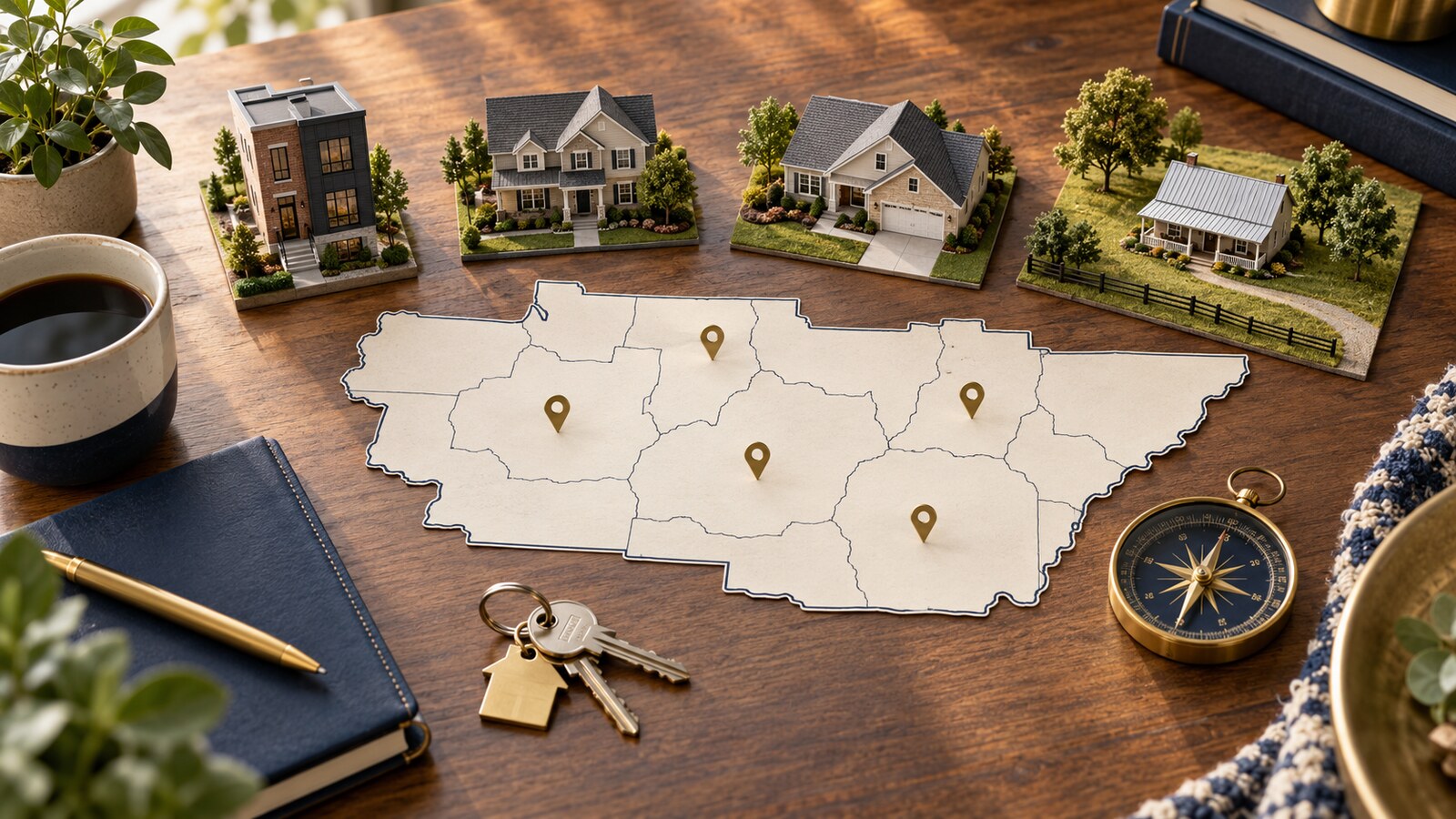
A Middle Tennessee relocation Realtor should help you compare Nashville, Franklin, Brentwood, Spring Hill, and communities west of Nashville according to the life you are actually trying to build—not just send listings across an enormous map. The right local partner narrows the region, plans efficient tours, explains property differences, and coordinates a remote or in-person purchase from the first conversation through closing.
Last updated: September 7, 2026.
This guide covers Nashville and Davidson County, Franklin and Brentwood in Williamson County, Spring Hill in Williamson and Maury counties, and the west-of-Nashville corridor through Bellevue, Fairview, Dickson, Burns, White Bluff, and Charlotte.
This is local research and practical relocation analysis from Harley Pope with Pope Real Estate Group at The Baker Brokerage. My goal is to help a relocating buyer choose the right part of Middle Tennessee before the home search becomes a blur of attractive listings spread an hour or more apart.
What Should a Middle Tennessee Relocation Realtor Help You Decide?
A relocation Realtor should help you identify which locations support your real priorities, then build the home search inside that smaller area. That means discussing the destination you need to reach regularly, your complete housing budget, preferred property type, appetite for maintenance, need for land, and how you expect an ordinary weekday to work.
I call that last part the Tuesday Test. A community can look great during a relaxed Saturday visit. The better question is what Tuesday will feel like: the morning drive, school or childcare logistics, errands, time at home, yard work, and the trip back from dinner or an evening activity. The house is not the entire goal. The life the house makes possible is the goal.
If you are still learning the regional map, begin with this broader guide to where to live in Middle Tennessee. Then use the comparisons below to decide which areas deserve a closer look.
How Do Nashville, Franklin, Brentwood, Spring Hill, and West of Nashville Differ?
Each area contains multiple neighborhoods and housing types, so no short description captures every property. Still, these starting patterns can keep a relocation search organized.
| Search area | Why a relocating buyer may consider it | What to examine closely |
|---|---|---|
| Nashville | Closer access to major employment, entertainment, healthcare, universities, and a wider mix of urban and established residential settings. | Neighborhood-by-neighborhood housing differences, parking, lot size, home age, renovation quality, traffic patterns, and ownership costs. |
| Franklin | A mix of historic character, established neighborhoods, newer communities, and access to the Cool Springs employment and retail corridor. | Whether the buyer wants downtown proximity, an established subdivision, newer construction, or land farther from the city center. |
| Brentwood | Established residential areas, larger homes and lots in many sections, and convenient access to portions of Nashville and Williamson County. | Home age, renovation needs, lot characteristics, subdivision restrictions, and the specific route to the buyer’s daily destination. |
| Spring Hill | Newer subdivisions, continued residential growth, and a range of homes extending across the Williamson–Maury county line. | County location, daily travel route, construction activity, builder or HOA documents, and differences between individual developments. |
| Bellevue and west Nashville | A western Davidson County option that can keep the buyer within Nashville while providing a more suburban residential setting in many areas. | Access to the buyer’s work corridor, home age, topography, flood information, road access, and neighborhood-specific housing patterns. |
| Fairview and Dickson County | Potential access to more land, smaller-city or rural settings, and housing choices farther west of Nashville. | Travel time, septic or sewer service, utilities, internet, road conditions, acreage upkeep, surveys, and property-specific due diligence. |
The point is not to declare one area better. It is to identify which tradeoffs match your priorities. A buyer who values an urban neighborhood and minimal yard work should not use the same search plan as someone who wants a workshop, outbuildings, or several acres.
When Does Nashville Make the Most Sense?
Nashville makes sense when access to a specific job center, medical facility, university, entertainment district, or established neighborhood is more important than maximizing land or square footage. The city includes everything from downtown condos and newer townhomes to older houses on larger lots, so “Nashville” still needs to be narrowed considerably.
West-side locations such as Bellevue, West Nashville, Charlotte Park, The Nations, Sylvan Park, West Meade, Hillwood, and Green Hills can produce very different searches even though they share the same city name. Housing age, street pattern, lot size, renovation level, parking, and access to major roads can change quickly.
A relocating buyer should begin with the destination that matters most, then compare the realistic routes from several neighborhoods. The Tennessee Department of Transportation’s traveler information tools provide current traffic and road-condition resources, including SmartWay. Use them at the times you would actually travel rather than relying on a single map estimate.
For a deeper starting point, see the guides to living in Nashville and narrowing Nashville neighborhoods by budget, commute, and home style.
How Should Relocating Buyers Compare Franklin and Brentwood?
Franklin and Brentwood are both in Williamson County, but the home search can feel different. Franklin offers several distinct choices: historic downtown surroundings, established subdivisions, newer planned communities, townhomes, and properties with more land outside the central areas. Brentwood is often associated with established residential neighborhoods, larger homes, and convenient positioning between Nashville and Franklin, but the age and condition of those homes can vary widely.
Do not reduce the comparison to city names or online rankings. Start with the buyer’s most frequent destination. Then compare the actual homes available within budget, the maintenance each property requires, the lot, and the route the buyer will use most often.
School assignments can also be property-specific and may change. Buyers should verify the current assignment directly with the applicable school system rather than relying only on a listing field or third-party website. The decision should be based on objective information and the buyer’s individual needs—not assumptions about who belongs in a particular community.
These detailed guides to living in Franklin, Tennessee and living in Brentwood, Tennessee can help you prepare a more focused visit.
What Should Buyers Know About Relocating to Spring Hill?
Spring Hill deserves a property-by-property search because the city spans Williamson and Maury counties. A buyer should verify the county, tax and utility details, school assignment when relevant, and the roads connecting the property to work and daily needs.
Many relocating buyers are drawn to the area’s newer subdivisions and modern floor plans. With new construction or a recently built resale, review the builder documents, HOA rules, drainage, grading, warranties, inspection options, and what remains planned around the community. A newer house can reduce some immediate renovation concerns, but it does not eliminate due diligence.
Spring Hill may be a logical part of a search that also includes southern Franklin, Thompson’s Station, and northern Columbia. The right grouping depends on the buyer’s destination and tolerance for daily travel. Our guide to living in Spring Hill provides more local context.
Who Should Consider Bellevue and Communities West of Nashville?
Bellevue can be a useful bridge between Nashville and the western side of Middle Tennessee. It allows a buyer to remain in Davidson County while considering a more suburban setting than many closer-in neighborhoods. From there, the search may expand toward Fairview, Kingston Springs, Pegram, White Bluff, Burns, Dickson, or Charlotte depending on budget, land goals, and travel needs.
Farther west, buyers may find options with larger lots, workshops, outbuildings, or rural characteristics that are harder to fit into a closer-in Nashville search. The tradeoff is that the property itself requires more investigation. Road access, topography, utilities, internet service, survey boundaries, easements, wells, septic systems, and the condition of outbuildings can matter as much as the house.
Tennessee’s Department of Environment and Conservation maintains public environmental and septic data viewers. The state also explains that inspection letters and permit records may be relevant when an existing septic system is tied to a property sale. Those records are valuable, but they should be combined with the contract’s inspection rights and advice from the appropriate licensed professionals.
Buyers should also check the official FEMA Flood Map Service Center and obtain property-specific insurance information when water or flood exposure could affect the purchase. A map is a starting point, not a substitute for survey, insurance, inspection, or other professional analysis.
For more detail on the western corridor, read the guide to living in Dickson, Tennessee.
How Does a Relocation Consultation Narrow the Search?
A productive consultation should turn a long list of appealing places into two or three realistic search zones. I would rather explain an important tradeoff early than let a buyer spend an entire visit crossing Middle Tennessee without learning much.
We work through six questions:
- Where must you go regularly? Work, family, medical care, airport travel, or another recurring destination.
- What is the complete monthly budget? Include principal, interest, taxes, insurance, HOA costs, and likely maintenance—not only purchase price.
- What type of home fits your ordinary week? Condo, townhome, established house, newer construction, or acreage.
- What will you maintain willingly? An older house, large yard, private road, septic system, pool, outbuilding, or none of those.
- Which compromises are acceptable? Less space, more travel, older condition, smaller lot, or fewer nearby conveniences.
- How will the move be coordinated? Current-home sale, temporary housing, remote purchase, financing, and timing.
This turns the first showing trip into a comparison rather than a sightseeing tour. If the buyer is purchasing remotely, it also establishes what should be covered during video tours, inspections, document review, and neighborhood orientation. The broader guide to moving to Middle Tennessee outlines more of that preparation.
What Should a Remote Home Tour Include?
A useful remote tour should show more than the best rooms. It should document the approach to the property, street context, neighboring uses, exterior condition, grade and drainage, visible utility equipment, room flow, storage, natural light, road noise, and anything that feels different from the listing media.
The agent should separate observation from expert evaluation. A video tour cannot replace an inspection, survey, title review, insurance quote, septic review, or other property-specific investigation. Its job is to help the buyer decide whether the home deserves the next level of due diligence.
How Do We Work With Relocating Buyers and Referral Partners?
Pope Real Estate Group helps relocating buyers compare communities, narrow the search, plan efficient visits, tour remotely when necessary, evaluate homes, and coordinate the transaction with the buyer’s lender, inspectors, title professionals, and other participants.
When another Realtor introduces the client, we also protect the professional relationship behind the referral and communicate at meaningful milestones. Referring agents can review how we serve as an out-of-state Realtor referral partner and use this guide to choose a Nashville Realtor for an out-of-state client.
Our service area is intentionally described with real boundaries. If a buyer’s final search belongs outside the communities or property types we serve well, we would rather say so and help identify the right local specialist than overstate our coverage.
Frequently Asked Questions
What areas does your Middle Tennessee relocation service cover?
Our core relocation coverage includes Nashville, Bellevue and west Nashville, Franklin, Brentwood, Spring Hill, Fairview, Dickson, Burns, White Bluff, Charlotte, Columbia, and nearby west-and-south Middle Tennessee communities. We confirm fit based on the buyer’s exact location and property type before beginning.
Can you help me compare Nashville with Williamson County?
Yes. We can compare actual housing options, recurring travel routes, home age, lot size, maintenance, ownership costs, and the buyer’s lifestyle priorities. The goal is not to declare one county better; it is to show what the buyer gains and gives up with each choice.
Can I buy a Middle Tennessee home without traveling for every showing?
Yes, many parts of the search and transaction can be handled remotely. We can provide detailed video tours, electronic documents, and local coordination. Buyers should still use appropriate inspections and professional due diligence rather than relying only on video.
Can you help if I must sell my current home before moving?
Yes. The planning conversation can include the current-home sale, financing, temporary housing, possession timing, and the risks of making either transaction dependent on the other. Your local listing agent, lender, and Tennessee agent should coordinate the sequence before you commit to dates.
Do you help with acreage and rural properties west of Nashville?
Yes, when the location and property fall within our working area. Acreage searches require added attention to surveys, access, easements, utilities, septic or well information, topography, outbuildings, and the buyer’s maintenance expectations.
How early should I contact a relocation Realtor?
Contacting an agent before the search becomes urgent gives you time to compare areas, prepare financing, coordinate a current-home sale, and plan a useful visit. You do not need to be ready to write an offer before beginning the location conversation.
Do you accept referrals from Realtors in other states?
Yes. We work with out-of-state real estate agents whose clients are relocating to Nashville or the Middle Tennessee communities we serve. Brokerage-approved referral terms and communication expectations should be documented before substantive work begins.
About Harley Pope
Harley Pope leads Pope Real Estate Group at The Baker Brokerage. Harley and Victoria Pope help buyers, sellers, relocating households, and referral partners across Nashville and the west-and-south Middle Tennessee markets.
Ready to Compare Your Middle Tennessee Options?
If you are relocating, the next useful step is not choosing a house. It is deciding which parts of the region deserve your time. Start a Middle Tennessee relocation conversation with Harley and Victoria Pope of Pope Real Estate Group at The Baker Brokerage. Tell us where you need to go, the type of home you want, and what you want everyday life to feel like. We will help you build the right search from there.

Brandon Baker
Business Development & Consulting | Brandon Baker | The Baker Brokerage LLC
or another way